
The Handmaid’s Tale
So, I’m going to be honest: I’ve only watched the first season of The Handmaid’s Tale. For this feat, I have to shout out my friend Kare, and my sister, whose name is so unubiquitous that if I put it on here she’d be exceedingly easy to trace, for getting me to finally watch it. And my goodness, what a time to begin watching the show! What a terrible horrible time—I actually wish I had watched it back when it first aired.
Also, in keeping with the spirit of honesty, the final nudge that made me start watching The Handmaid’s Tale was finding out Poussey from Orange Is the New Black (forgive me for not using her real name) was cast in the role of Moira on the show. You see, I have never really gotten over Poussey’s murder on Orange Is the New Black, and Taystee’s conviction from it, and I began watching The Handmaid’s Tale because at least Poussey’s alive in this one. And yes, if you are wondering, this is an admission that I am biased so… do not take anything I say as gospel. But I digress. This here is the tale of the Gilean Handmaids—and not even really about them, but about us.
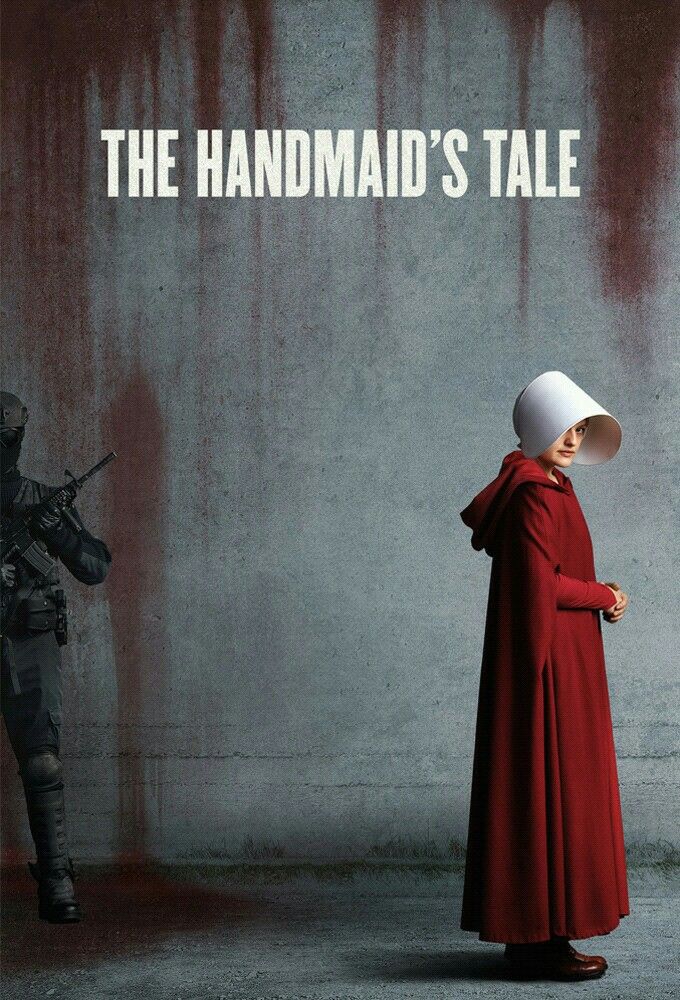
The Handmaid
We meet Offred in the first episode, introduced as a woman held captive who meets her friend Moira, a gay black woman, when she they are both forcefully made a part of The Handmaids. Their role is to make babies for the wealthy and ‘righteous’ families of Gilead because their women are barren. We later find out during Offred’s examination that a lot of these ‘righteous’ men are sterile, something she makes a point of telling us has been classified as a forbidden word. The doctor even offers to have sex with her stating that she will be blamed for not falling pregnant, sort of inferring that it is an open secret that handmaids use other methods to fall pregnant. But again, I digress. This is not about the characters but about us.
Descent Into Fascism
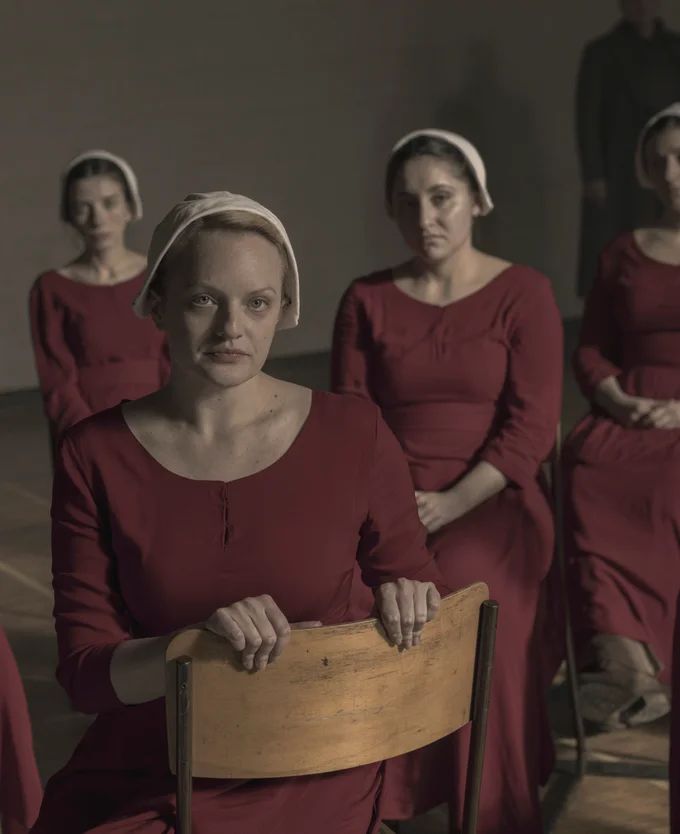
We learn quickly that the characters are in shock. They cannot believe that this is their portion. Janine even laughs when she finds herself in the class about Ruth offering Bilhah to her husband Jacob for sex. But the signs have always been there: the slow but steady decline into fascism that I believe is the premise of the show is all there. So, let’s get into it.
Offred is a formally employed woman before the coup. I refrain from using working woman because women work and have always worked, the only difference is Offred was paid for her labour. She says that she has four thousand dollars in her account when she and Moira find out that women are no longer allowed to own any property. Her husband, on the other hand, sort of happy with himself, asserts that he will take care of his wife, something we see is impossible when Offred is kidnapped and her child stolen by the guardians within the first fifteen minutes of the pilot—turning the entire logic of husbands being protectors and providers on its head, a talking point popular within masculinity forums and parroted within femininity and trad-wife forums to justify colonial and bio-essentialist gender assignments and roles.
However, it is clear that husbands cannot individually fill those shoes, especially when contending with state surveillance and violence. And fine, even like in Luke’s case, a man can be one of the good ones: they can love their spouses, and meet all the thresholds set for one to be considered a masculine man, but when the rubber meets the road, they are still only just a man.
The Other
Offred, upon realising that women are actively being pushed out of public life, attends a protest alongside her friend Moira (I’m sure most, if not all, humans of good will can relate to attending a protest). They and their counterparts, just like ourselves, believed that they could negotiate, that showing their displeasure loudly would somehow alter the progression into their subjugation. They believe in the social contract between them and the state. They forget it is voidable. They are shocked when the police shoot at them, killing their comrades. They are hit with the realisation that they are expendable. Ironically and perhaps fatally, in several other flashbacks, we see them talk about how it was necessary for armed officers to parade the streets to avoid a terrorist attack. We see they had consented to the increase in militarisation because they believed it would keep them safe. They just never expected that they would be the target of the violence.
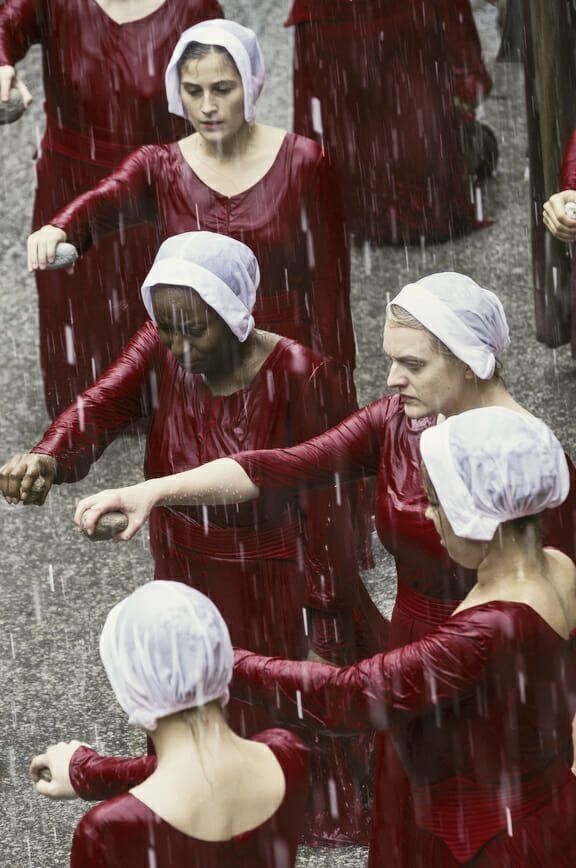
For Offred, it was no harm, no foul, as long as it was the terrorists being killed, or the foreigners being shot; all good as long as she was the in group from her vantage point. This is something she doesn’t ever really let go of because we see her affirm the existence of an “us and them” dynamic even once she is a handmaid, only difference being she is now on the receiving end and she acknowledges that this time she did not get to pick sides. She was othered from the very beginning; her position in the fight already decided by those who oppressed her just like the position of “terrorist” is determined by the oppressor in the show, as is in the real world with the Al Shabaab, Hamas, Hezbollah and all other resistance groups.
In or Out?
We also get to meet Nick, a spy in the Watford household. Watching his recruitment today, it is easy to draw parallels between that and the recruitment we see of young men into the burgeoning red pill movement. Nick is unable to find a job and comes from an unstable upbringing, then he meets a man who asks him to join a meeting of the Sons of Jacob where he might eventually get a job. The Sons of Jacob are like an Andrew Tate podcast: they believe women are straying away from their gendered role and it is their duty as men to rectify that.
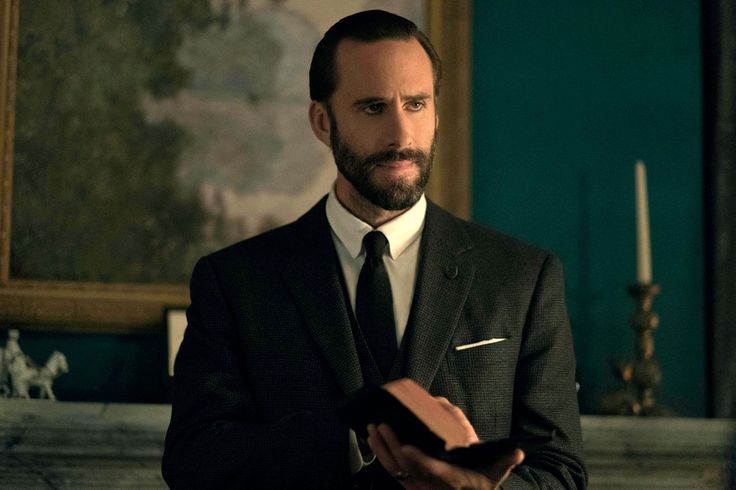
A few months later, the coup takes place and Nick is assigned to the Watford family. His role in the Watford household lays bare another fallacy: that by having a patriarchal society, men are automatically safe. Nick spies on Commander Watford for the regime, demonstrating that maintaining power comes with paranoia—not just of outsiders but of ‘insiders’ too. He also has a relationship with Offred, and similar to Commander Watford, we see that he harbors not only a desire for intimacy, but with an equal—even if it is by his own invention.
We can also possibly say that he was a victim of sexual violence when he was asked by Mrs. Watford to have sex with Offred, but it is implied that this was a convergence of interest between the two. And it is this same interest that leads to Offred’s questioning and physical assault by Aunt Lydia and the guardians. If Nick existed in today’s society, he would probably call himself a nice guy, one of the good ones; only ever a victim of circumstance where he would miraculously always get what he wanted. What a coincidence!
Patriarchy Princess
Speaking of Mrs. Watford, I presume when the first season aired she would have seemed like an outlier, as someone operating outside the norm. She would probably be a Candace Owens or a Mumzee, a Nigerian influencer. But with the alarming rate at which the gurls are regressing, and watching the show now, she could be anybody. She is any woman whose class interests align with their desire to be partnered with a man to consolidate capital within a monogamous nuclear family set up. Gilead is her brainchild, and while she may not have any children (so far), she is what Hitler would proudly consider the mother of the Fatherland. Her contribution is overt, and I do not intend to spend time exploring that.
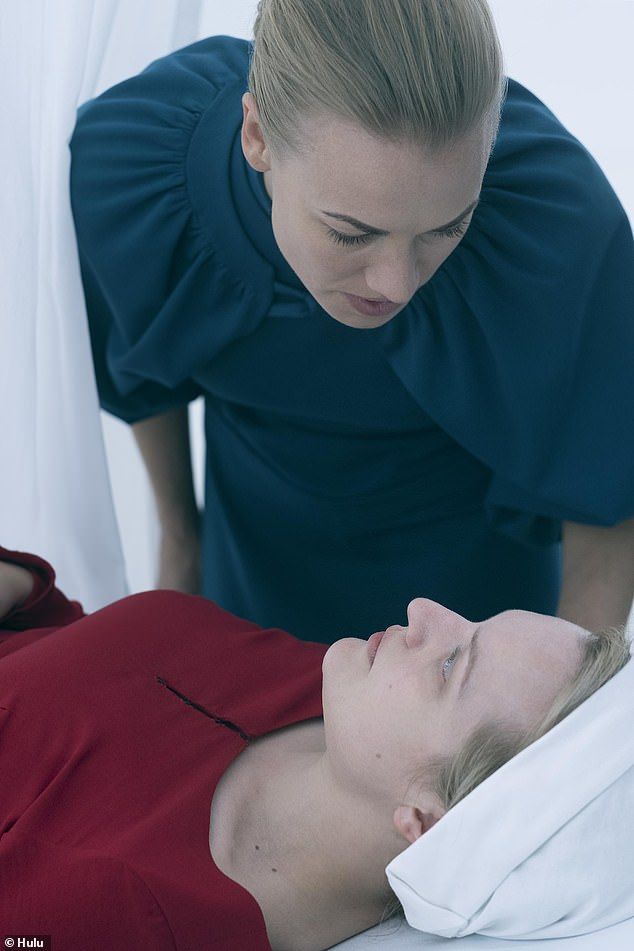
However, Mrs. Watford’s dissatisfaction is something to note. She, just like her husband, spearheaded the creation of a state where they would be surveilled. In her mind, she had found the benevolent patriarch, a man to pray with, to be submissive to, to cure her gender anxiety. A lot of women believe this only to end up recreating the violence they claim to be from ‘bad men’ just like Mrs. Watford. She is a good example of people whose desire for power is met by having an underclass that is easily exploitable and therefore easy to abuse without consequence. An example of a society whose people are okay with abuse as long as they can transfer the abuse they endure to others they deem less deserving.
Better For Some…
While I may or may not give an update once I finish all the six seasons of this horror show, I take notice that by Margaret Atwood’s own admission, nothing she has written is new but they are stories of enslaved black women living under white supremacist, capitalist and violent systems. We see this clearly with Ofglen the second, a woman who prior to the coup was a drug addict pushed into sex work in order to sustain herself. And whereas Offred is in shock at the violence she has to endure, Ofglen sees her present circumstances in life as significantly better than the life she had when Offred was enjoying her liberties before the coup.
Ofglen’s arc as contrasted with Offred’s shows how our ability to ignore the affliction of others due to abandonment by the state and ourselves is eventually a path to create the same afflictions for ourselves. While we enjoy our freedoms, whatever we consider oppressive and our worst-case scenarios are already happening to those we have othered and deemed deserving of neglect. It is our privilege that shields us, and it can be easily taken away if it is no longer profitable for the ruling class.
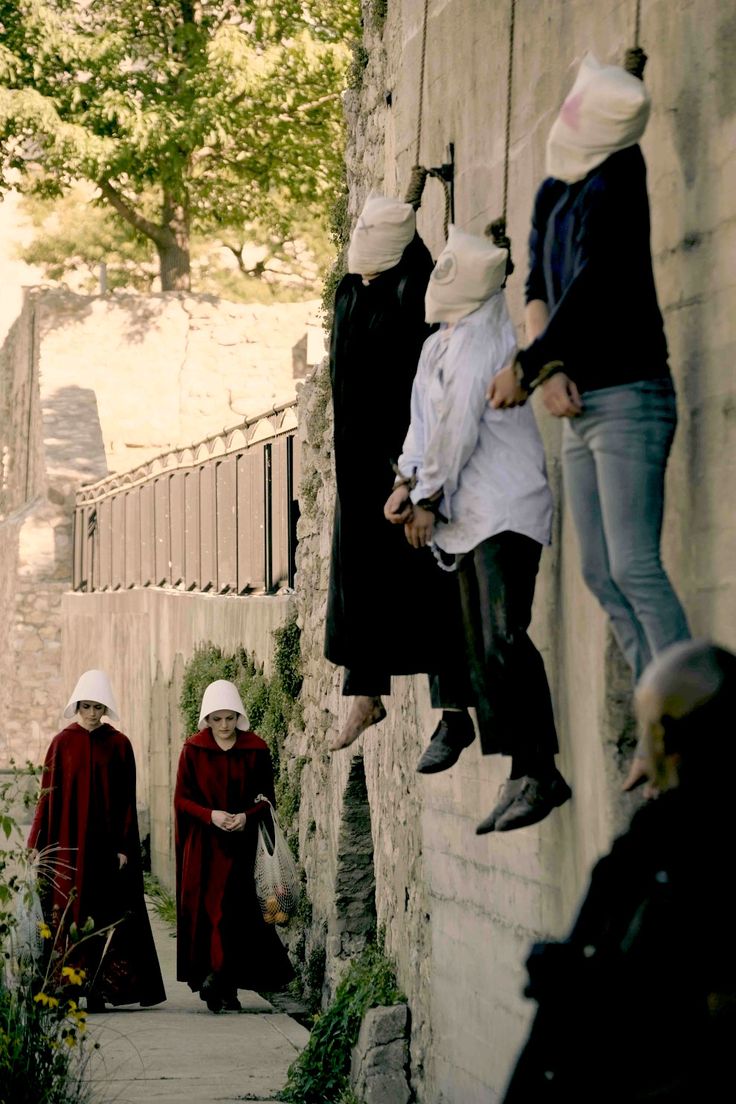
I will end with a quote by Mr. Watford. “We wanted to make the world better… Better sometimes means worse for some.” So please, look outside because the signs are all here.
~Y
You might also like
More reviews coming soon!